23 February 2026
We often treat confidence as a prediction of success: “I am confident I will win this match.” Many assume this type of confidence — the deep, unwavering belief in our inevitable success — is essential to actually achieving it. That is certainly one type of confidence, but it isn’t self-confidence. That is simply the belief that you will achieve a specific outcome due to the specific conditions in a specific scenario. It is a calculation of probability, a highly-biased calculation of probability. But it is important to remember that there is no guarantee of any outcome in life, no matter how probable it appears. Tying your confidence to successful outcomes ties your sense of self-worth on variables you do not control. If your confidence requires a “win” then every unknown factor — a subjective grader, an unexpected exam question, a shift in someone’s mood — becomes an existential threat to your ego. You spend energy trying to control the uncontrollable, terrified that a failure will mean you are fundamentally inadequate.

Confidence isn’t entering every room knowing you are the smartest person, armed with the perfect thoughts to guarantee success. It’s walking into a room, pitching your best (and most ambitious) idea, participating as your collaborators tear it apart, and knowing that you and your project will benefit from it. It is not a loud but fragile prediction of success. It is the quiet, unbreakable trust in your self.
The Architecture of Confidence
Self-confidence is often pictured as swagger. It is that person who enters a room absolutely certain they will crush the presentation, ace the exam, and win praise and awards with every action. This is, however, backward.Self-confidence is trust that I have the resources to handle whatever happens. Trust in myself that I will be ok, regardless of the outcome.
We often treat confidence as a prediction of success: “I am confident I will win this match.” Many assume this type of confidence — the deep, unwavering belief in our inevitable success — is essential to actually achieving it. That is certainly one type of confidence, but it isn’t self-confidence. That is simply the belief that you will achieve a specific outcome due to the specific conditions in a specific scenario. It is a calculation of probability, a highly-biased calculation of probability. But it is important to remember that there is no guarantee of any outcome in life, no matter how probable it appears. Tying your confidence to successful outcomes ties your sense of self-worth on variables you do not control. If your confidence requires a “win” then every unknown factor — a subjective grader, an unexpected exam question, a shift in someone’s mood — becomes an existential threat to your ego. You spend energy trying to control the uncontrollable, terrified that a failure will mean you are fundamentally inadequate.
Illusion of Certainty
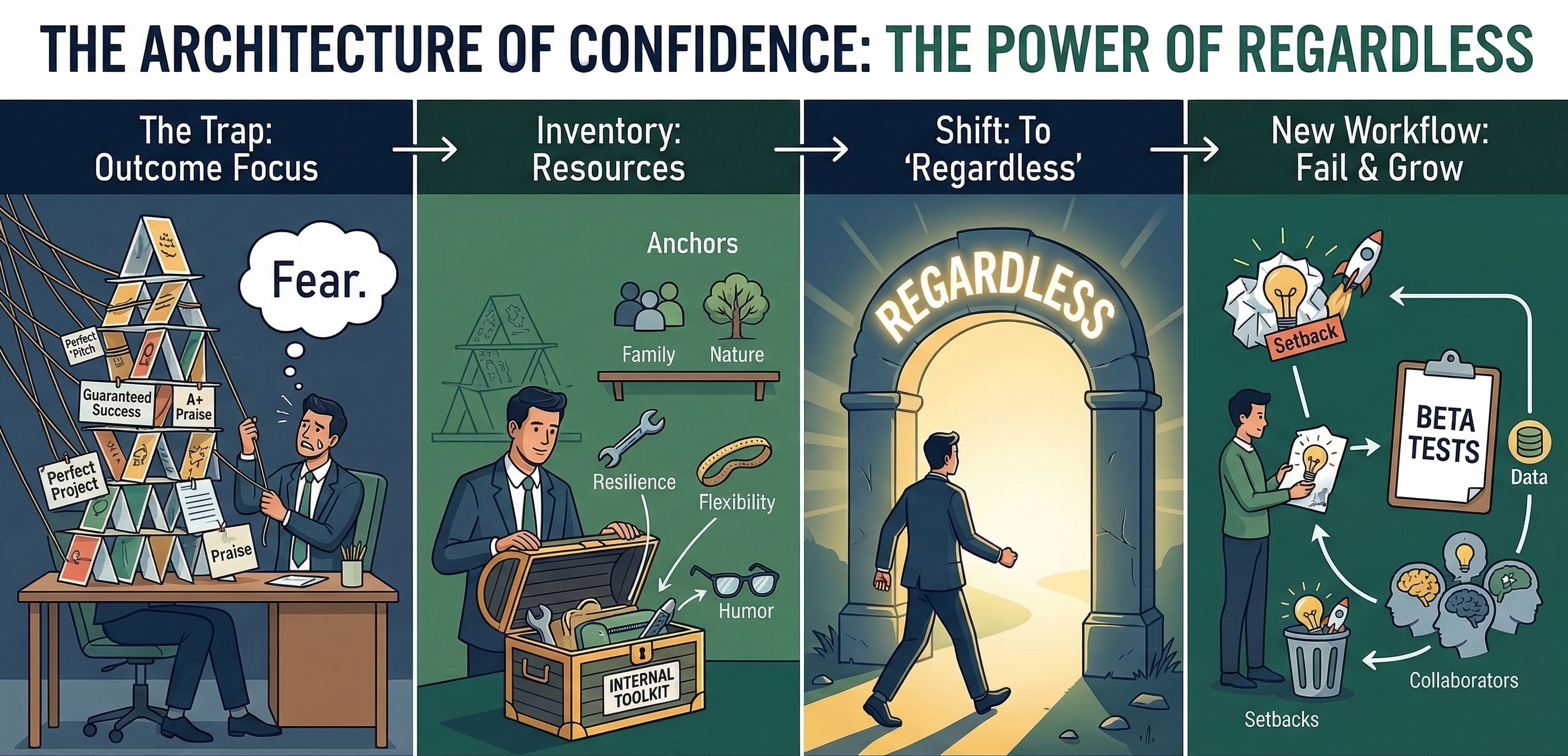
The Academic Trap: In my career as a research scientist, we are trained to control variables. We meticulously design experiments specifically to eliminate uncertainty. In many fields, including your academic work, we are rewarded for precision, predictability, and bulletproof plans. Because this approach appears to work well in many professional settings, it is tempting to apply this same rigorous framework to control the uncertainty in our lives and our reputations. We fall into the trap of trying to engineer our personal and professional success, convincing ourselves, “If I just perfect this application …” or “if I anticipate every possible criticism …” or “if I think of the exact right thing to say … then I could succeed.” We try to micromanage the world to guarantee our own value. The Fragility of “Outcome Confidence”: The problem is that life is not controllable. When your confidence relies entirely on the world handing you a “win,” you are incredibly fragile. If your self-worth is tied to a specific result; a single rejection or a less-than-stellar quiz score doesn’t just mean a project needs revision, it threatens your sense of self. These challenging events are challenging because they undermine any evidence we used to build our self-worth. When you realize that you cannot control every variable or guarantee a positive outcome, “outcome confidence” reveals itself for what it truly is: a house of cards constantly at the mercy of critics, external circumstances, and sheer chance.Taking Inventory of your “Resources”
What does it mean to have the “resources” to handle whatever the future holds? “Resources” often conjures thoughts of money or status, but personal resources are far more accessible and far more reliable. The Internal Toolkit: The resilience to sit with criticism and mine it for useful information that can lead to self-improvement; the emotional flexibility to admit being wrong; the humor to laugh at yourself. Ultimately, your internal toolkit is the capacity to take any event — both apparent triumphs and apparent disasters — as a chance to learn, to grow, and to live. The External Anchors: These anchors are things like the groundedness of family; the support of your social group, the simple act of stepping outside into nature. These are not just distractions; they are the tangible resources that prove the world does not end when an external hurdle appears. They remind us that our identity is not entirely dependent on our latest ‘success’.The Power of “Regardless”
Shifting from outcome confidence to self confidence introduces a powerful workflow concept: success regardless of this outcome. Ending the “Waiting Mode”: The fear of failing can be paralyzing. Many high achievers fall into “waiting mode,” putting off the work until we feel completely “ready” so that “success” feels guaranteed. That fear fades completely when you trust that you will be successful regardless of the outcome. When you stop viewing failure as fatal, it loses its power over you. The focus shifts from protecting your ego to simply doing the work. The Freedom to Fail: When you operate from a place of self confidence, failure stops being an indictment of your character or your capacity. It just becomes one part of life guiding your growth using the resources you already know you have. “Setbacks” become beta test. Critics become a group of minds helping you improve the next iteration. It is just data to feed back into your own improvement.
A New Baseline
Confidence isn’t entering every room knowing you are the smartest person, armed with the perfect thoughts to guarantee success. It’s walking into a room, pitching your best (and most ambitious) idea, participating as your collaborators tear it apart, and knowing that you and your project will benefit from it. It is not a loud but fragile prediction of success. It is the quiet, unbreakable trust in your self.